Showing posts with label Underwater Photography. Show all posts

Thursday, 24 June 2010

Basking Sharks

As soon as I landed at Heathrow from Milan on Monday I received an email from Dr Alex Tattersall who had space on a Charles Hood's boat "Logan." on Wednesday for a Basking Shark trip. The sharks, the second largest fish in the sea, are something that I have wanted to see since I was very small. Even though it called for an early start (4:00 a.m.) and a four hour drive before we even got on the rib, I jumped at the chance. We were pretty lucky with the traffic to Penzance, and met Charles at the quay. A quick wait for the tide to come in and we donned out kit and jumped into the 7.5m RIB and made the 20 minute journey to the first bay where the sharks had been spotted the day before. It was not long until the first fin was spotted. The shark however had no intention of hanging around and was determinedly swimming out to sea. For the next couple of hours we scoured the coastline and sea for signs of the triangular fin sticking out of the water but to no avail. We rounded Land's End and into Sennen Cove when we heard a shout from the bow. A basking shark had breached just 100m from the front of the boat, the resulting splash was enormous. within a few minutes we were in the water with the cameras waiting for the first shots, the shark did a quick fly by then disappeared. Sadly no one managed any shots but at least we had seen another one.
The searching continued, there were some pleasant distractions along the way as we spotted a Sunfish and some seals but what we really wanted were some baskers. Finally we found a fin and then another one, and then another. Charles positioned Logan about 100 yards ahead of he sharks and we all slid quietly into the water and waited. Soon enough the sharks appeared out of the green murk and disappeared as quickly as they came and kept circling us for several minutes.
Charles advised us that the trick with the sharks is to keep fairly still on the surface and let them pass you, if you make too much noise or move too quickly they are off. It is a balance of sticking your head out of the water to locate the dorsal fin and then getting your head down back under water and waiting for the shark to appear.
There were a couple of occasions, just when you think the sharks have gone, one suddenly appears from behind or the side, the first time it happens it is a little unnerving but a great experience.
We spent about 2 -3 hours in the water with sharks towards the end of the day, they weren't always cooperative and we were jumping in and out of the RIB to reposition ourselves as the sharks moved along the coast, which in itself is pretty tiring, especially if you have too much weight on your weight belt!!
I was using my 5D in an Aquatica housing with a Canon 15mm f2.8 fish eye lens and an 8.5" dome port. This was great for getting the whole shark in view but i found myself wanting a bit more zoom. I switched half way through the day to the 17-40mm f4 L and had was able to zoom in a bit but the murky water meant that the only way to get really clear shots is the old underwater adage, get close then get closer!
We drove home via McDonalds and eventually walked through my front door at 12:00 so it was a pretty long day, but it was certainly worth it. I am looking forward to repeating the trip next year.

Tuesday, 15 June 2010

Underwater Snoot, Selsey Pier

My first dive at Selsey Pier and I decided to make life hard for myself by trying to use a snoot that I have just obtained. The snoot work was tricky to say the least as the tide was on the flood and the tiny movements made getting the light in the correct spot hard. I think that next time I will use an off camera strobe in a fixed position and shoot form there. The shot on the left is of a small scorpion fish that was lying on the bottom. The viz was about 2 meters so the snoot is an effective way of reducing backscatter in murky waters. It also creates a pleasing black background and really isolates the subject in a beam of light.
I am looking forward to my next underwater trip, hopefully I will be able to see some nudibranchs and try out the micro snoot.

Underwater In Swanage

I have been lucky enough to get a couple of days diving in Swanage and get some good visibility as well. I found my first UK Sea Slug, which doesn't sound that glamourous but I love them :) The one on the left is Flabellina pedata and was about 1.5cm long so I was using a 100mm Macro lens with a canon 500D diopter, 2 Sea & Sea YS110 aplha strobes: 1/200 f16 ISO 200 on a 5D camera.
I managed to meet up with some other keen underwater photographers so a good weekend was had by all. I also managed some deeper dives down to 22m looking for larger aquatic life, sadly the viz was not great so no pics there.

Saturday, 28 November 2009

Photo of Diver and Goatfish Wins Underwater Photo Contest.

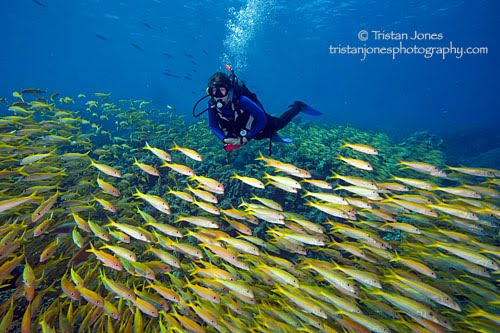
Whilst out in Egypt I entered an underwater photographic competition with the photo on the left and was lucky enough to be selected as the winner by the judges. I took it on the first dive of the trip at Erg Abu Ramada, when I found a large school of Yellow Tail Goatfish (Mulloidichthys vanicolensis ). I asked the model to swim through the school so I could capture the image above.
Settings used: 1/80s f10 ISO200 @ 17mm, 2 Sea & Sea 110 alpha strobes set to 1/2 power to illuminate the fish.

Saturday, 15 August 2009

CDWS Blue Magazine Front Cover.

For a photographer, getting a front cover shot is always a bit of a buzz. This one is especially so for me as it is my first "Underwater" cover. The shot is of World Champion freediver and record holder Sara Campbell. It was taken in January this year an the Giannis D wreck in Egypt as part of a video and photo shoot she was doing for the underwaterchannel.tv. Sara managed to break the 100m depth mark on just one breath on April 9th this year. We had a lot of fun shooting at the wreck as it was relatively shallow (18m) and with just the 3 of us, (Sara, Debbie from Blue Eye FX doing the video and myself doing the stills) it was a beautiful dive.
Even if the water is really clear, as it was on this dive, it is always best to get as close to the subject as possible when taking photos underwater. To this end I used my 15mm fisheye behind an eight inch dome port on a Canon 5D. The full frame sensor gives you a true 15mm, unlike some of the cropped sensor cameras which enabled me to shoot the entire wreck from fairly close on, hence keeping image quality as high as possible. To get realistic colours, I manually white balanced on the wreck at the depth I was shooting and used a Magic Filter in the rear gelatin filter holder on the 15mm to get better blue colour rendition.
For a few more shots of Sara, you can visit my website.

Thursday, 16 July 2009

Dorset Diving.

With a week or so away from golf photography, I have been able to slip into the water for a dive or two. The water here has warmed up considerably from the 7 degrees C we had at Christmas time. A balmy 18 degrees signaled it was time to don the 5mm wetsuit and spend some quality time with the creatures under Swanage Pier. I did a couple of solo dives under the pier and then persuaded my girlfriend to venture into UK waters for the first time. This enabled me to get someone to model for me for some wide angle shots under the pier. This in itself was quite challenging as the visibility was not at its best but I managed a couple of shots. I also went for another dive with Alex Mustard who wanted to get some shots of Tompot Belnnys for an article he is writing for a diving magazine.
I also spotted my first flatworm on this dive (pictured right) as well as 2 different species of pipefish and a scorpion fish.
I have uploaded some more shots of the other creatures that I found here. It always amazes me how much life can be found in UK waters and I would highly recommend it. I was using my Canon 5D with a 100mm macro lens and occasionally a 500D dioptre for the smaller stuff. I was also testing out two Sea and Sea YS 110 Alphas that I have just bought. These are a lot lighter than my other strobes, (YS 250 Pro), but still pump out enough light to be hitting apertures of f22 at 200 ISO.
Next week off to Spain for the Open de Espana Femenino 2009.

Tuesday, 10 March 2009

Blue O2 HEPCA dives & Sara Campbell

The day after returning from Q-School, I was packing my bags for Egypt. I was off to Hurgharda for diving photography with a twist. The main reason for the trip was to take part in the reef clean-up dives organised by HEPCA. This involved taking some dives out of the usual schedule and instead diving shallower, well used areas, picking up glass, plates, plastic bags, fishing line, basically anything that should not have been in the sea. There was also some fantastic diving to be had with warm clear water and some great wrecks. There was the obligatory visit to the SS Thistlegorm, as well as the Carnatic, Dunraven and Ghiannis D. We also had world record holding free diver Sara Campbell on board so we had a great photo shoot with her underwater at the Ghiannis D for her website and sponsors (left). To watch her gracefully glide through the water on one breath was fantastic, she looked so unencumbered compared to me in all my diving gear.
Live-aboard diving is always great due to the diversity of people that are on board. Luckily, I had a great bunch with me that week, with several budding photographers on board who spent a fair few hours quizzing me on all things photographic.
For most of the wreck images I used a Canon 5D with a 15mm Fish Eye lens and a magic filter cut to fit the rear filter holder. No strobes were used, just natural light, so shooting with the light and white balancing every few metres is a must.
More photos of the wrecks can be seen here.

Sadly, all too soon, it was time to head back to England and the slightly cooler waters of the South Coast.

Diving at Swanage


One of my many photography goals is to build a catalogue of species that inhabit the coastal waters of the UK. Obviously it takes thousands of dives over many years to compile such a thing, so on the 24th December 2008 I was in the water again. The water off Swanage Pier  was a chilly 7 degrees C with visibility not much more than three feet. Still, with a macro lens you can get close enough to the subject to get around most of the 'viz' problems, although particulate matter in the water can be a nightmare with the associated backscatter. For macro work, I tend to use a Canon 100 mm f2.8 macro lens with a couple of Sea & Sea YS250-Pro strobes attached. If I know that the critters are going to be really small then I might add an extension tube or diopter to the lens. In this case I just used the 100mm on its own.

Despite the bad viz, I managed to find some interesting critters to shoot, including  Scallops, (top), a female Black Faced Blenny, (below), and a few Snakelocks Anemonea. After 90 minutes of diving and despite the drysuit, I had numb fingers and could no longer work the camera so, I
 decided that discretion was the better part of valor and got back into the car where I could at least try to prevent the onset of hypothermia. Roll on the trip to Hurgharda (Egypt) in January for a tour of several wrecks in the Northern Red Sea :)